

The breakout horror film isn't about Gen Z, alienation, or AI. It's about your mind.
CAUTION: PLOT SPOILERS AHEAD
Listen to podcast version here:
Media commentary by Steve Dunlop
Backrooms has become a cultural and economic juggernaut. Created by 20-year-old filmmaker Kane Parsons, and inspired by an Internet meme, it has already earned more than $100 million worldwide and sparked endless debate about what it means.
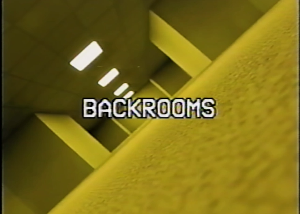
Title card for Backrooms, a 2026 film by Kane Parsons. Displayed under Fair Use as provided in US copyright law.
Many critics see the film as a portrait of Gen Z anxiety: alienation, economic insecurity, digital overload, even fears surrounding artificial intelligence.
But is that what Backrooms is really about?
There are many ways to interpret art, of course. Yet none of these explanations fully account for the film's rich symbolism and recurring imagery. The key, I think, is to view Backrooms not as a commentary on a generation, but as an expedition into the unexplored regions of the human mind.
The story hooks us almost immediately on a deeply compromised figure we know only as Clark. He aspires to be an architect, but instead finds himself running a strip-mall furniture business that has fallen far short of his ambitions.
That failure curdles into resentment. He externalizes blame: toward colleagues, toward circumstance, and most pointedly toward his wife, whose eventual departure is framed less as a sudden rupture than as the consequence of his own sustained anger.
Backrooms introduces a therapist at exactly this point. In the horror genre, therapy is incidental, if it’s there at all. Here, it’s a threshold. It is precisely while making progress in therapy that Clark’s boundaries begin to blur. Something is sapping his energy.
Speaking of energy, we now learn that Clark is baffled by mysteriously high utility bills at his store. An electrician investigates, and finds a basement circuit box drawing power in ways that defy explanation.
Not long after that, Clark discovers a hidden dimension and enters the backrooms: endless corridors, flickering lights, fortress-like piles of furniture, disconnected spaces, a disorienting soundtrack, and the nagging sense that everything is connected even when it appears random.
At the gateway to this world, Clark encounters backwards stop signs. Critics have largely ignored them, yet they may be the film’s most revealing image. Stop signs are a warning to keep out. Only when viewed from inside the subconscious do these signs read frontwards. “Stop” becomes a warning to what lurks below to stay there.
Inhabiting the backrooms are grotesquely warped figures - representing Clark’s cluttered memories, fractured relationships, and the emotional wreckage he’s caused to people in his orbit. Sigmund Freud might have recognized the therapist, the pirate furniture store mascot, and Clark himself as competing elements of the psyche—superego, id, and ego locked in conflict.
Observing it all, we learn, has been a researcher named Phil - a clipboard carrying, lab coat wearing cliche. A narrative counterweight to the therapist, Phil attempts to explain the mind through imaging, measurement, and empirical data. But he ultimately underscores the limits of that enterprise. Scanning, mapping, and measuring the brain is not the same as understanding it.
What does Kane Parsons make of it all? We don’t really know. He’s been circumspect when discussing the film's meaning. What we do know is that Backrooms repeatedly returns to images and ideas that are far easier to understand as a journey through the collective unconscious than as a commentary on artificial intelligence or generational angst.
With mental illness now one of the most widespread health conditions in the US, it speaks not just to Gen Z, but to everyone. Backrooms is not asking us to confront AI. It is asking us to confront something far more disquieting: the possibility that the darkest unexplored territory is not in the algorithms, but in ourselves.