BOB, OSCAR AND ME

Who are the people in your neighborhood?  This Sesame Street founding cast member was one.  The author’s chance encounter with him on the trails of Tallman Mountain made an impression that will last a lifetime

By Lisa M. Duchin

It takes a special kind of celebrity to live in Rockland County, just north of New York City in the lower Hudson Valley.  It is a magnet for people who want to work in the arts, but who haven’t been sucked up into the Hamptons ethos.  I have a special respect for a celebrity who has the means to live wherever they want, but who chooses to live among us.   On the banks of the Hudson, we have a diverse range of backgrounds, demographically and economically.  It’s not a perfect world, but it feels as though everyone here at least tries to get along. 

The local celebrity story I’d like to share isn’t about Bill Murray, Angelina Jolie, or any of the Hollywood superstars who’ve called Rockland their home.  It is about a kind, unassuming man who initially came across to me as just one of “the people in my neighborhood.”

It was early March, 2020 – a very worrisome time.  Not only was there fear of a novel coronavirus that was making its way through Europe, but my son had just come home ill from college, and although he’s fine now, we hadn’t yet nailed down what was wrong with him.   (P.S. – it wasn’t COVID.) 

So I did what I normally do.  I retreated to the forests and the parks that make Rockland the sanctuary that it is.  Long, meditative walks are my exercise of choice, and I often walk in Tallman Mountain State Park.   I thrive on walking.  It’s great therapy. 

One of my usual rest stops along the main north-south Tallman trail is a spot I like to call “the Evan Bench.”  (Someone carved the name “Evan” into the seat.)  This time, I see an elderly couple on the bench, chatting and relaxing.  I didn’t want to rush them by hovering, so I kept my distance.   After a couple of minutes, they got up and began walking slowly away, so I started to move in.

“Are you going to sit on that bench?” the woman asked.

“Not if you still need it.  Are you through with it?”

“Oh, yes – we’re done.” 

I sat down on the bench and started some deep breathing exercises.  Then, the man spoke up – a gentle soul with a very inquisitive way about him.

“Have you lived here long?”  he asked. 

“Yes, I have, actually I’ve lived here almost 25 years.”

“Do you like it here?”

“Oh, I love it here!”

“We just moved here,” he announced.   

“Well, you are going to love it here,” I gushed.  The man had just hit on one of my favorite topics.  “If you love parks, this is the place for you.  Each one has a different personality.  They provide places for meditation and forest bathing, and they all have different moods.”  

I started in with some of the highlights, from the Piermont Pier to the Erie Path to Nyack Beach, all within walking distance.  

“Plus,” I added, “this community is brimming with such a rich and varied history.  The Tappan Zee, the Lenape people, the Dutch, the Revolution – just so much.” 

“Are you a teacher?” he asked.

“Why do you say that?”

“You’re just very animated.  You have the energy of a teacher,” he observed.   “You seem like you taught young children.”  

I actually had taught young children, at the very beginning of my career.    How did he pick up on that? 

“I see film production crews every now and then around here,” he continued.   

“Well, you know, we’re Hollywood-on-the-Hudson,” I said.

“What kinds of things should I watch if I want to see this park?”

“Well, the series You on Netflix, for one.  There’s a murder scene that was shot down there closer to the riverbank.   Penn Badgley buried the body.  There’s The Sinner, Orange is the New Black – a lot of stuff gets shot here in Rockland.” 

“You seem to know a lot about television,” he said. 

“Well, I used to work in the media, and my husband is a former news anchor.” 

The woman spoke up again. 

“Do you know who you’re talking to?” 

“My new neighbors!”  I responded playfully.  But she asked me again - a little more slowly and seriously this time. 

“But... do you know who you’re talking to?”

I suddenly felt like a third-grade student who didn’t know the answer in class. 

“No...”

“Did you ever watch Sesame Street?” she asked. 

“Of course!  Of course...”

“Well... this is Bob.” 

Bob McGrath, a childhood fixture for me and millions of others my age, was now 88 years old.  He watched me study his face.  I’m a video editor.  I examine expressions and do match frames all the time.  As soon as that context was there, it didn’t matter how old Bob was.   I could see the young man within. 

I had watched Sesame Street growing up.  I always identified with Oscar the Grouch, thanks in no small measure to my dysfunctional family of origin, where I had been maligned and misunderstood from my earliest years.   Of course I loved Grover and Kermit, Bert and Ernie – but for me, it was all about Oscar.   Oscar was misunderstood, too. 

“Bob, from Sesame Street,” his wife repeated.  Bob just stood there, smiling at me.   Friendly, very warm, and very, very approachable. 

I got a little emotional.  I couldn’t help it.  My inner child had suddenly come to the surface – and so had Bob’s. 

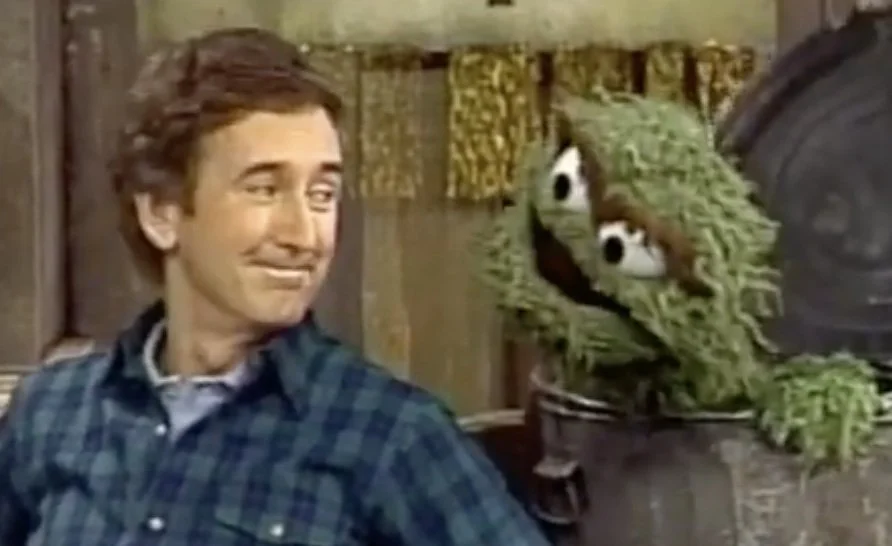
“You’re – you’re Oscar’s best friend!!”

“I am!” he proclaimed. 

“I can’t believe – I can’t believe I’m meeting Oscar’s best friend!!”

“Do you know Oscar invited me down to tour his apartment?”

“You went into Oscar’s apartment??”

“I did!” Bob was proud of that.

“Was it nice?” 

“As you can imagine, it was a little cramped.”

“Like most New York apartments?”

“Well, it was a little bigger than just the garbage can, you know.” 

A flash of all those Sesame Street skits dashed across my mind.   Bob did short bits with all the Muppets – but for me, it was primarily about misunderstood Oscar. 

In the media industry, you meet celebrities all the time.   Sometimes you even have to work with your idols.  Once I realized Bob was going to stick around, I squelched my inner groupie and just enjoyed the moment, human to human.   

He asked about my family.   I told him my husband Steve and I had met when we both worked at NBC’s headquarters, 30 Rockefeller Plaza. 

“We met on the 7th floor, where local news is.” 

“I worked at 30 Rock too,” Bob volunteered.   “Back when I first came to New York.”  I was thrilled that we had this in common. 

“Wow!   What did you do there?”

“Well, have you ever heard of Mitch Miller?”

“Mitch Miller?”  I said.  “Isn’t that the guy who had the TV sing-along with the on-screen lyrics?”

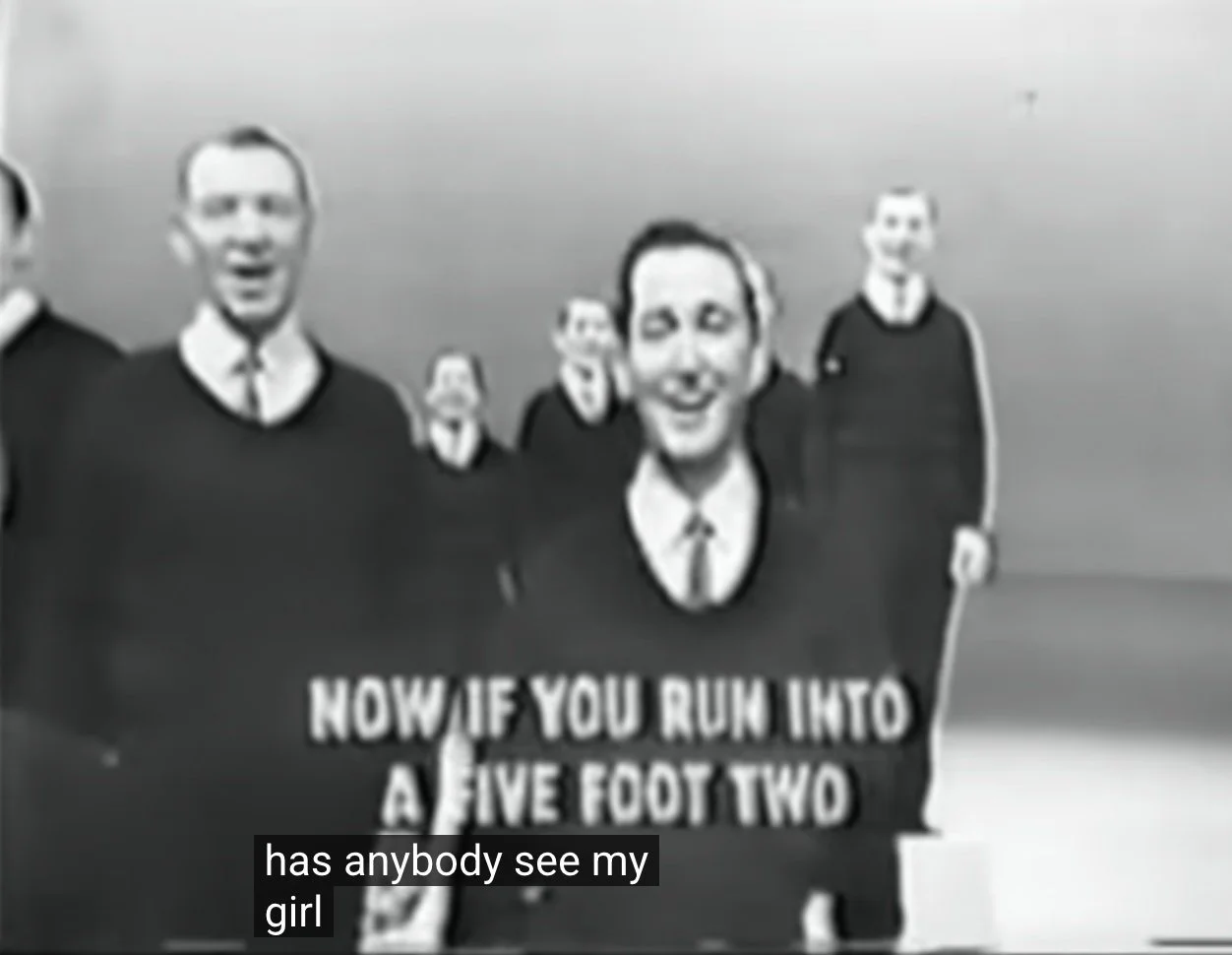
Bob McGrath, foreground, on Sing Along With Mitch, NBC-TV, circa 1961.

“Yeah!”   Bob smiled, apparently impressed that I knew who Mitch Miller was.   Bob was the lead tenor on the 1960’s NBC-TV series Sing Along With Mitch, which was taped in the famous Studio 8-H, which has been home to Saturday Night Live now for almost 50 years.

“My husband told me about watching Mitch Miller as a kid with his family!” I said.  “I’ve got to FaceTime him.”  

It was a mild March afternoon, and I reached Steve while he was working in our front yard.  He was using the unseasonably warm weather to finally take down the Christmas lights.  Steve was already in high school when Sesame Street premiered in 1969, so he didn’t grow up with it like I did.  But his first job out of college was at a small radio station that featured American pop standards, and the playlist was heavy on Mitch Miller. 

Steve and Bob quickly bonded over Sing Along songs - including one of my husband’s favorites, a novelty tune about a midcentury comic strip character named Barney Google.  

When Steve’s FaceTime with Bob was done, he handed me back my phone.  “I’ve got an idea,” I said.  “Could you sing Barney Google for Steve?   I’ll record you and bring it back to him.”  

Bob was immediately game.  Without any warm-up, he was live – singing Barney Google, playing to the lens of my iPhone like the professional he was. 

Barney Google

With his goo-goo-goo-galy eyes

Barney Google...

The next lyric actually goes...

...had a wife three times his size...

But Bob didn’t sing that.   He looked straight at me, and changed the lyrics on the spot:

Barney Google, has a wife three times YOUR size...

I smiled at Bob.  His eyes twinkled back.  His kindness with those lyrics made it seem as if he knew about all my struggles with weight. 

Of course, Bob was most famous for his song, “Who Are The People In Your Neighborhood?”   And here, it was as though we had become instant friends – just like any two people in any neighborhood. 

I got the feeling Bob would shoot the breeze with me all day, if he could.  His wife was so patient with the thunder I was giving him, but, being married to a former TV figure myself, I was sensitive to her body language.  It was time to move on.  

The three of us continued south on the Tallman Trail, walking and talking, talking and walking, until we reached the spot where the aqua blaze turns right, onto a narrow dirt path heading into the woods. 

“This is a little too treacherous for you,” I told Bob.  He had become somewhat bow-legged with age.   “Well... until next time!” 

I waved goodbye.  When we had first met back at the Evan Bench, less than an hour before, we had shaken hands.  Little did I know that would be my last handshake with anyone for nearly two years.  The following week, the White House banned travel from Europe, and before long, New York and much of the country was on COVID-19 lockdown. 

Solitary, socially-distanced walks like mine then became the principal source of exercise for thousands of Rocklanders whose gyms were forced to close.  I unearthed an Oscar The Grouch t-shirt I had bought at the Palisades Mall when my son was two years old.  I wore it the next few times I went to Tallman, in the hopes of running into Bob again.    So much for keeping my inner groupie in check.

But I never thought that encounter, in March of 2020, would be both the first and the last time I would see Bob McGrath. 

I recently learned that the Bob of my childhood – Oscar the Grouch’s best friend - died on December 4, 2022, in Norwood, New Jersey, at the age of 90. 

If I had a celebrity to choose to run into, in the woods – the place where I walk, decompress, meditate, and try to connect with my adventurous inner child – I couldn’t think of a better person than Bob McGrath.   We met while I was out playing in my Tallman playground.    

And then I realized I wasn’t being a groupie at all – since it was actually Bob who had befriended me first.  To me, he will always be a fine human being.  Then, and only then, a celebrity. 

When I came home to Steve, I was like a happy child wanting to share what happened at recess.  “I just met Oscar The Grouch’s best friend!” I exclaimed with glee.   Then, I played him Bob singing Barney Google in the middle of Tallman Park on my smartphone.   

On Sesame Street, Oscar The Grouch had a special nickname for Bob.  He called him Bright Eyes.  Whenever I see Oscar again - whether it’s on TV, on someone’s t-shirt, or just as the love-worn toy my neighbor keeps in her garage - I’ll think of Bright Eyes, too. 

Lisa M. Duchin, Dunlop Media’s managing partner, is a longtime Rockland resident, avid hiker, and owl watcher. 

© 2026 by Lisa M. Duchin

Listen to Bob singing the tenor part on this 1962 recording of Barney Google with Mitch Miller and the Gang.

THE EXEC WHO KNEW TOO MUCH

He was one of the smartest people I’d ever coached.  Which turned out to be part of the problem.

Listen to podcast version here:

FROM THE CENTER - The Exec Who Knew Too Much, by Steve Dunlop

Media commentary by Steve Dunlop

About a decade ago, I was asked to work with a senior executive at a Fortune 100 company known for hiring the best and the brightest.

The smarter the executive, the more susceptible they may be to information overload. Photo courtesy of EuropeInvest via Unsplash.

On paper, he had it all: intelligence, experience, impeccable credentials, and a résumé that would impress anyone.

Yet whenever he had to deliver a major speech or sit for an important media interview, he reverted to an extraordinary ritual.

His staff prepared briefing books that were sometimes an inch thick—hundreds of pages of background material, charts, graphs, talking points, and possible questions. The night before an appearance, he would stay up late, studying them as if he were cramming for a final exam.

At first, I admired his diligence. Eventually, I realized something else was going on.

Despite his expertise, he didn’t trust himself to know what he already knew.

I’ve come to recognize this pattern repeatedly among highly accomplished leaders. The smarter and more knowledgeable the executive, the more susceptible he or she may be to information overload.

Psychologists have a name for this phenomenon: the “curse of knowledge.” In a landmark 1989 study, economists Colin Camerer of the Wharton School at the University of Pennsylvania, George Loewenstein of the University of Chicago, and Martin Weber of the University of Mannheim in Germany found that experts often become prisoners of their own expertise. They know so much that they struggle to distinguish between what audiences truly need to know and what can safely be left unsaid.

Educational psychologist John Sweller expanded on that insight with his pioneering work on Cognitive Load Theory. Sweller found that when working memory becomes overloaded, performance deteriorates. The problem is not a lack of intelligence; it’s that the brain’s processing capacity is finite.  

And the same problem exists on the receiving end. In 1956, Princeton psychologist George Miller demonstrated that listeners have surprisingly limited capacity to process information at one time. Yet many executives still attempt to prepare for high-stakes appearances by memorizing mountains of detail.

When I first began working with my exec who knew too much, progress was slow.  Very slow.

But over time, he adopted a different approach: instead of memorizing information, he learned how to organize it. Once he could distill complex ideas into a few clear, memorable stories, his confidence soared.  He eventually left his senior leadership role at the firm – and became the CEO of another major company in the same industry.

The experience taught me an enduring lesson: many communication problems are not really communication problems. They are confidence problems.

At some point, every leader has to stop studying for the exam and trust what they already know.

@ 2026 by Dunlop Media Inc. All rights reserved.

THE DAY ALAN GREENSPAN TOLD ME SOCIAL SECURITY WAS FIXABLE

Washington had just flinched.  He said hesitation was the real danger.

Listen to podcast version here:

FROM THE CENTER - The Day Alan Greenspan Told Me Social Security Was Fixable, by Steve Dunlop

Media commentary by Steve Dunlop

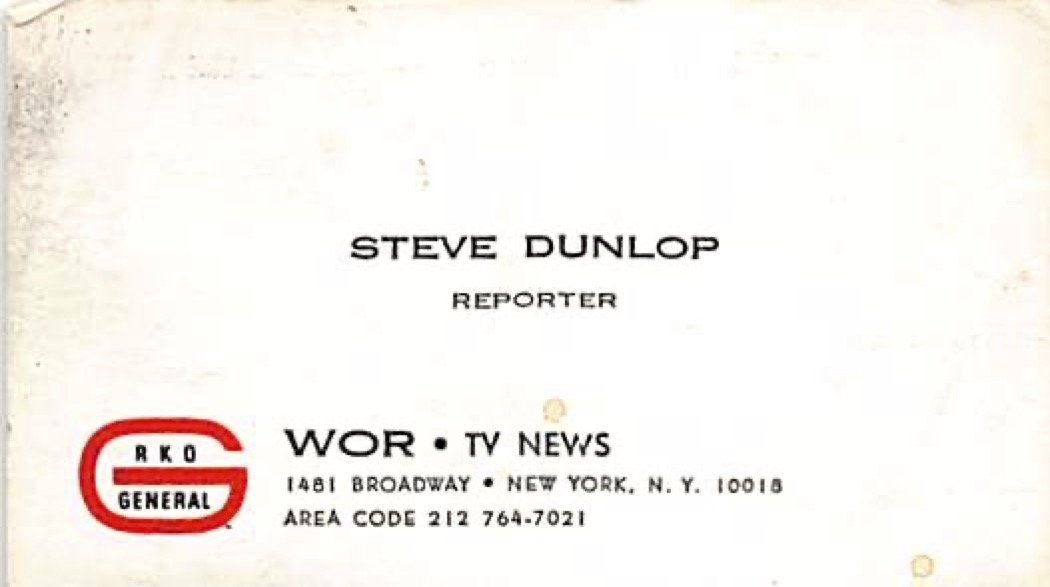
Forty-four years ago, I sat down with Alan Greenspan in his Lower Manhattan office to interview him for News at Noon on New York’s WOR-TV.  

The business card I was carrying when I interviewed Alan Greenspan in 1982.

This was years before he became chairman of the Federal Reserve. At the time, he was leading President Reagan's bipartisan commission charged with finding a way to rescue Social Security from a looming financial crisis.

I was a young reporter. He was already a well-known economist.

What I remember most is not just what he said. It's how he said it.

Greenspan struck me as congenial, almost avuncular. Bespectacled and unflappable. The kind of person who could discuss an approaching fiscal train wreck with the same demeanor someone else might use to explain the weather.  There was also a dry wit lurking beneath the surface. He seemed genuinely amused by the drama swirling around issues that most economists regarded as arithmetic.

Alan Greenspan, the former Federal Reserve chair, in an undated photo from his Wikipedia page.

His office resembled something out of Mad Men.  He had an expansive picture window that looked out on New York Harbor.  He smoked a pipe.  His secretary sat at an electric typewriter. When he needed information, he asked for printed reports, not PDFs or Excel spreadsheets. The future chairman of the Federal Reserve was working in a world that now feels almost prehistoric.

What he told me, however, sounds remarkably current.

The commission had not yet delivered its final recommendations. But Greenspan was happy to discuss the challenge facing Social Security. His message was straightforward.  The problem was real, serious, and solvable.  But only if policymakers acted before circumstances forced their hand.

That was hardly a popular message at the time.

Just a year earlier, in May 1981, a Republican senate had handed Ronald Reagan an early political defeat by overwhelmingly rejecting proposals that would have curtailed Social Security benefits for early retirees.  The vote was 96-0. 

House Speaker Tip O'Neill responded by helping cement a phrase that would become part of the American political lexicon: Social Security was the "third rail" of American politics. Touch it and you die.

Even then, elected officials understood the danger.  Greenspan understood something else.  Demographics and economics do not care about politics.  The arithmetic eventually arrives.

What strikes me now is that the warning was delivered nearly half a century ago.

The commission eventually produced a bipartisan compromise. Congress acted. Social Security was stabilized. The immediate crisis was averted.

Yet here we are, more than four decades later, having essentially the same conversation. Not because nobody saw the problem or understood the math, and certainly not because nobody sounded the alarm.

They did.  I know because I interviewed one of them.

What I remember from that afternoon is not a prophet predicting disaster. Quite the opposite. Greenspan's argument was that disaster was avoidable. His point was that delay would narrow the available choices.

That observation feels every bit as relevant today as it did in 1982. The details have changed. The political characters have changed. The technology has certainly changed – the electric typewriters are gone, of course. But the fundamental challenge remains remarkably familiar.

Some problems are difficult because we don't know how to solve them. Others are difficult because we do know how to solve them. We simply postpone the decision.

Forty-four years later, that is the most enduring lesson I carried away from Alan Greenspan's office.

WHY FREUD WOULD LOVE BACKROOMS

The breakout horror film isn't about Gen Z, alienation, or AI. It's about your mind.

CAUTION: PLOT SPOILERS AHEAD

Listen to podcast version here:

FROM THE CENTER - Why Freud Would Love Backrooms, by Steve Dunlop

Media commentary by Steve Dunlop

Backrooms has become a cultural and economic juggernaut. Created by 20-year-old filmmaker Kane Parsons, and inspired by an Internet meme, it has already earned more than $100 million worldwide and sparked endless debate about what it means.

Title card for Backrooms, a 2026 film by Kane Parsons. Displayed under Fair Use as provided in US copyright law.

Many critics see the film as a portrait of Gen Z anxiety: alienation, economic insecurity, digital overload, even fears surrounding artificial intelligence.

But is that what Backrooms is really about?

There are many ways to interpret art, of course. Yet none of these explanations fully account for the film's rich symbolism and recurring imagery. The key, I think, is to view Backrooms not as a commentary on a generation, but as an expedition into the unexplored regions of the human mind.

The story hooks us almost immediately on a deeply compromised figure we know only as Clark. He aspires to be an architect, but instead finds himself running a strip-mall furniture business that has fallen far short of his ambitions.

That failure curdles into resentment. He externalizes blame: toward colleagues, toward circumstance, and most pointedly toward his wife, whose eventual departure is framed less as a sudden rupture than as the consequence of his own sustained anger.

Backrooms introduces a therapist at exactly this point. In the horror genre, therapy is incidental, if it’s there at all. Here, it’s a threshold. It is precisely while making progress in therapy that Clark’s boundaries begin to blur. Something is sapping his energy.

Speaking of energy, we now learn that Clark is baffled by mysteriously high utility bills at his store. An electrician investigates, and finds a basement circuit box drawing power in ways that defy explanation.

Not long after that, Clark discovers a hidden dimension and enters the backrooms: endless corridors, flickering lights, fortress-like piles of furniture, disconnected spaces, a disorienting soundtrack, and the nagging sense that everything is connected even when it appears random.

At the gateway to this world, Clark encounters backwards stop signs. Critics have largely ignored them, yet they may be the film’s most revealing image. Stop signs are a warning to keep out. Only when viewed from inside the subconscious do these signs read frontwards. “Stop” becomes a warning to what lurks below to stay there.

Inhabiting the backrooms are grotesquely warped figures - representing Clark’s cluttered memories, fractured relationships, and the emotional wreckage he’s caused to people in his orbit. Sigmund Freud might have recognized the therapist, the pirate furniture store mascot, and Clark himself as competing elements of the psyche—superego, id, and ego locked in conflict.

Observing it all, we learn, has been a researcher named Phil - a clipboard carrying, lab coat wearing cliche. A narrative counterweight to the therapist, Phil attempts to explain the mind through imaging, measurement, and empirical data. But he ultimately underscores the limits of that enterprise. Scanning, mapping, and measuring the brain is not the same as understanding it.

What does Kane Parsons make of it all? We don’t really know. He’s been circumspect when discussing the film's meaning. What we do know is that Backrooms repeatedly returns to images and ideas that are far easier to understand as a journey through the collective unconscious than as a commentary on artificial intelligence or generational angst.

With mental illness now one of the most widespread health conditions in the US, it speaks not just to Gen Z, but to everyone. Backrooms is not asking us to confront AI. It is asking us to confront something far more disquieting: the possibility that the darkest unexplored territory is not in the algorithms, but in ourselves.


SEVEN SECRETS TO GREAT LIVE STORYTELLING

A New York sportscasting legend shows how it’s done.

Media commentary by Steve Dunlop

Listen to the podcast version here

As anyone who’s been through one of our narrative, media, or presentation trainings knows, it’s one thing to be taught. It’s another thing to execute. It’s why once you learn our SPAR® methodology, we emphasize repeated recording and playback - so we can track not just the quality of your story, and how you handle questions around it, but how you come across physically - with your energy level, voice, body language and eye contact.

Early in my news career, I was privileged to work alongside an individual who combined outstanding narrative skill with delivery skill, and I’d like to share a sample of his work with you. He made it seem easy on an almost daily basis. I’m talking about the legendary New York sportscaster, Bill Mazer (1920-2013).

Watch this 2 1/2 minute clip from 1985, where Mazer delivers a succinct but utterly original profile of one of baseball’s greatest figures, Babe Ruth, as part of a series called “The Great Ones.”

We can break down seven secrets to Mazer’s success and identify them here. They’re as follows:

1. Rock solid eye contact with the camera.

2. A delivery that’s energetic, but authoritative and empathic at the same time.

3. Communicating warmth outdoors on a January day, when the temperature barely cracked freezing.

4. Gestures and facial expressions that are natural, not theatrical or forced.

5. He knows his material so well that there’s no script - it just would have gotten in the way.

6. He tells two fully formed stories about Ruth - or depending on how you’re counting, three - in less than the time it takes to boil an egg.

7. And unless you’re a Babe Ruth expert, the content will be new and surprising to you, even today.

As I wrote following Bill Mazer’s death in 2013, his approachable style was pretty much the same, whether the cameras were on or off. “What you see is what you get,” he once told me. You can sum it up in one word: authenticity.

Thanks for the lessons, Bill. You’re one of The Great Ones, too.