Dunlop Media

THINK. SPEAK. EDUCATE. ™
  • Clients
  • Overview
    • Mission
    • Methodology
  • Capabilities
    • LEVEL ONE: Strategic Narrative Design
    • LEVEL ONE: Communication Readiness-Print and Online
    • LEVEL ONE: Media Training-Broadcast and Video
    • LEVEL ONE: Organizational Alignment Workshops
    • LEVEL TWO: Media Crisis Training
    • LEVEL TWO: Business Presentation Training
    • LEVEL TWO: Executive Communications Leadership
    • LEVEL TWO: Office Hours
    • Remote Training (all levels)
  • Team
    • Steve Dunlop
    • Lisa M. Duchin
    • Bob Fasbender
    • Charles Feldman
    • Denisse Oller
  • Press Center
    • Dunlop Media Archives
    • Photo Gallery
    • Podcast
    • Commentary
    • Suggested reading
    • About the Press Center
  • Request info
  • Clients
    • Mission
    • Methodology
    • LEVEL ONE: Strategic Narrative Design
    • LEVEL ONE: Communication Readiness-Print and Online
    • LEVEL ONE: Media Training-Broadcast and Video
    • LEVEL ONE: Organizational Alignment Workshops
    • LEVEL TWO: Media Crisis Training
    • LEVEL TWO: Business Presentation Training
    • LEVEL TWO: Executive Communications Leadership
    • LEVEL TWO: Office Hours
    • Remote Training (all levels)
    • Steve Dunlop
    • Lisa M. Duchin
    • Bob Fasbender
    • Charles Feldman
    • Denisse Oller
    • Dunlop Media Archives
    • Photo Gallery
    • Podcast
    • Commentary
    • Suggested reading
    • About the Press Center
  • Request info
earth-PIXABAY-373716_1920.jpg

From The Center

  • Dunlop Media Archives
  • Photo Gallery
  • Podcast
  • Commentary
  • Suggested reading
  • About the Press Center

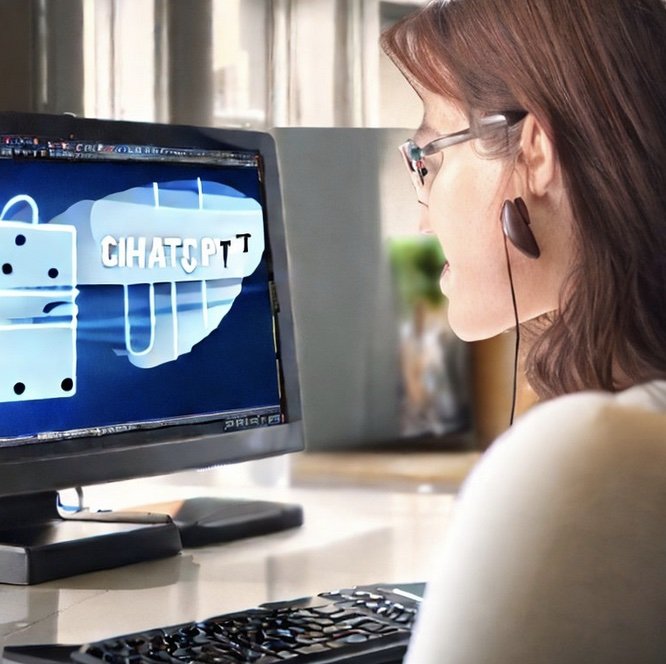
A digital human (not real) using ChatGPT. Image generated by Stable Diffusion using AI technology.

Does ChatGPT Think You're Dead?

Steve Dunlop June 8, 2023

Learning about AI “hallucinations”

Media commentary by Steve Dunlop

Listen to the podcast version here

We’re well into the digital age, and by now you’ve surely googled yourself to see what the search results say about you.  Maybe you do so regularly. 

But have you ever tried ChatGPT’ing yourself?  Maybe you should.

Not long after I hosted an online panel on artificial intelligence and the future of journalism, I embarked on a modest experiment.  I asked ChatGPT to write a three-paragraph essay about my career as a television reporter and anchor.  It returned a series of inaccuracies that AI experts now refer to as “hallucinations.” But the essay was so deftly written that it carried a seductive air of truth. 

“He began his career as a reporter for WABC-TV in the 1970’s,” the essay wrote.  Wrong.  I never worked at WABC.  I was a news writer for the AP and a radio reporter on Long Island in the 1970’s, and later a news editor at WOR Radio.

The essay claimed I moved to WNEW-TV’s Ten O’Clock News in 1975.  That was eight years off.  I started at the Ten O’Clock News in 1983 before moving on to WNBC, and later, CBS News.

ChatGPT went on to call my reporting on 1977’s “Son of Sam Murders” perhaps my “most notable achievement” and claimed I became a “respected authority on the case.” 

But I never covered Son of Sam.  

It stated I was “one of the first reporters on the scene.”   But anyone who remembers the case knows there was no single “scene” to be at – Son of Sam was a string of murders at a variety of locations, and the first was actually in 1976.  

I asked a few of my journo colleagues to replicate my AI experiment, and they got back similarly false results.  Like the old newsroom saying goes, never let facts get in the way of a good story. 

How about the big stories of the era that I did cover?  The Bernhard Goetz subway vigilante case, the insider trading probe of Ivan Boesky, the Robert Chambers “Preppy Murder” trial, the sentencing of the Mafia Commission, the construction and opening of the Javits Center, and Donald Trump’s brushes with bankruptcy, among others?  ChatGPT made no mention of any of them. 

The algorithm did try to flatter me, though.   ChatGPT claims I was known for my “friendly and approachable personality,” called my approach to journalism “thorough and insightful,” and claimed my non-existent Son of Sam reporting was “praised for its sensitivity.”  If I had made some of these claims on my resumé, I could stand accused of fraud at worst, puffery at least. 

As a storyteller, however, ChatGPT does have one admirable instinct:  it saves the best for last.   In closing, it wrote, “his contributions to the field of journalism and his impact on the New York City media landscape continue to be remembered and celebrated to this day... “

...although, it added, “he passed away in 1999.” 

As Mark Twain said when a newspaper mistakenly published his obituary, “reports of my death are greatly exaggerated.”  At least Twain could cable the editor to get a correction.  Who can I contact?   Beats me.  Which is yet another problem with AI.  

Maybe the need to set so many records straight will be good for actual journalism in the long run.   But those of us for whom truth and facts are coin of the realm already had our work cut out for us by the deluge of fake news.   The advent of AI will only make misinformation more ubiquitous – and the need to debunk it more urgent.  

If you don’t believe that, try asking ChatGPT to write a three-paragraph essay about yourself.    And good luck getting a correction.

1 Comment

The British crown jewels on display in the Tower of London. Photo by Annie Spratt via Unsplash.

THE "ROYAL WE" IN EXILE

Steve Dunlop September 20, 2022

King Charles’s first speech portends a revamped communications style

Media commentary by Steve Dunlop  

Listen to podcast version here

The American humorist Will Rogers is credited with originating the axiom that “you never get a second chance to make a first impression.”   If Rogers were alive today, he would probably reconsider.   Despite our ubiquitous “cancel culture,” contemporary society has witnessed figure after figure get a second chance from the public - from Tiger Woods to Arnold Schwarznegger to Robert Downey Jr. to Martha Stewart.    

Enter Britain’s King Charles III... who for reasons well known around the world has suffered a more severely battered reputation than perhaps that of any other modern monarch.   As recently as five years ago, a poll found more than half the British public would have preferred to see the Crown bypass Charles and go directly to his son, Prince William. 

But now, the Commonwealth and the world mourn the death of the beloved Queen Elizabeth II.  In his first public speech as King, Charles had to hit a home run – or a “six”, if you’re playing cricket.  If you believe, as I do, that what we say and how we say it really matters, take note.

In a deeply personal, nine-minute address to the British nation, King Charles used the first person singular pronouns of I, me, my and mine a total of 46 times.  He used first person plural of we, us, and our, referring to his family and his country, less than a dozen times.   But the pluralis majestatis, a linguistic use of “we” referring to the monarch himself or herself, more commonly known as the “royal we” – was not used at all.  That was conspicuously absent. 

The British press has noted that Queen Elizabeth used the “royal we” frequently.  Its coinage goes back to the late 1100’s, originating with the concept of the divine right of kings.  It started to fall out of favor in the Victorian Age. 

But in 1997 came the tragic death of the hugely popular Princess Diana.  Queen Elizabeth sequestered herself with her grandchildren in Scotland, leading to withering media criticism, almost unheard of for a sitting British sovereign.  Why, the papers asked, was her Majesty so distant from her grieving nation?  

When she did return to address her subjects after five days of silence, the Queen adopted a changed and highly personal tone.    “What I say to you now, as your Queen and as a grandmother, I say from my heart,” she said.  “First, I want to pay tribute to Diana myself...”

The Royal We went into exile.   In its place would come a concerted effort by the House of Windsor to appear more approachable, human, even vulnerable... and by the time he assumed the British throne, King Charles’s reputation had recovered significantly.   

Business communicators should be cautious in following this royal example.  In general, reporters expect that top executives are speaking for their entire organization, so the use of the “royal we” is, counterintuitively, ok.   On the other hand, if you’re telling a story based on your personal experience, the first person singular is almost always the way to go. 

As it will be, generally, for Britain’s new sovereign.   The success of, and positive public reaction to his first address as monarch makes it clear that for kings, as with anyone else in a media saturated age, there can be second chances to make a first impression. 

Comment
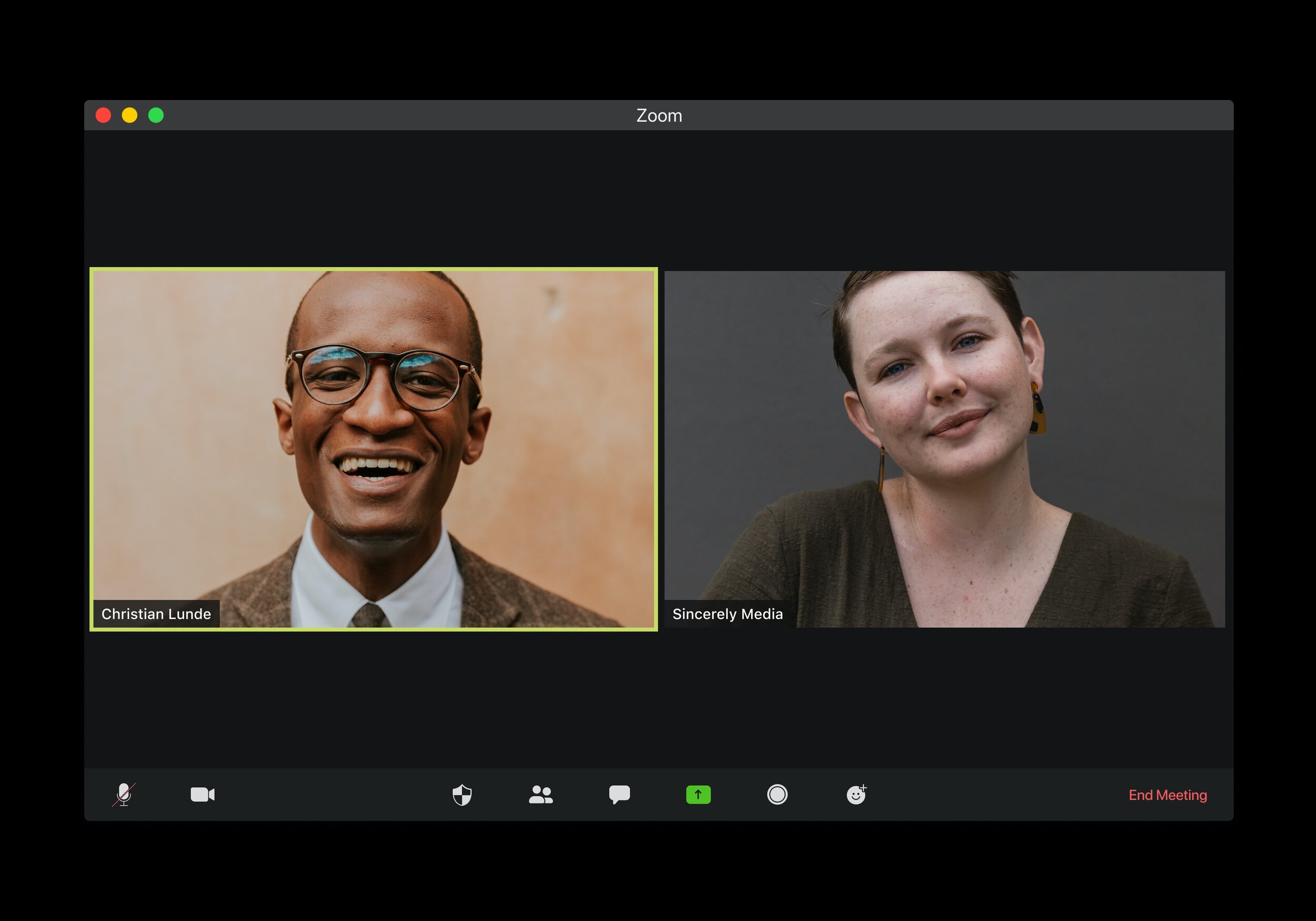
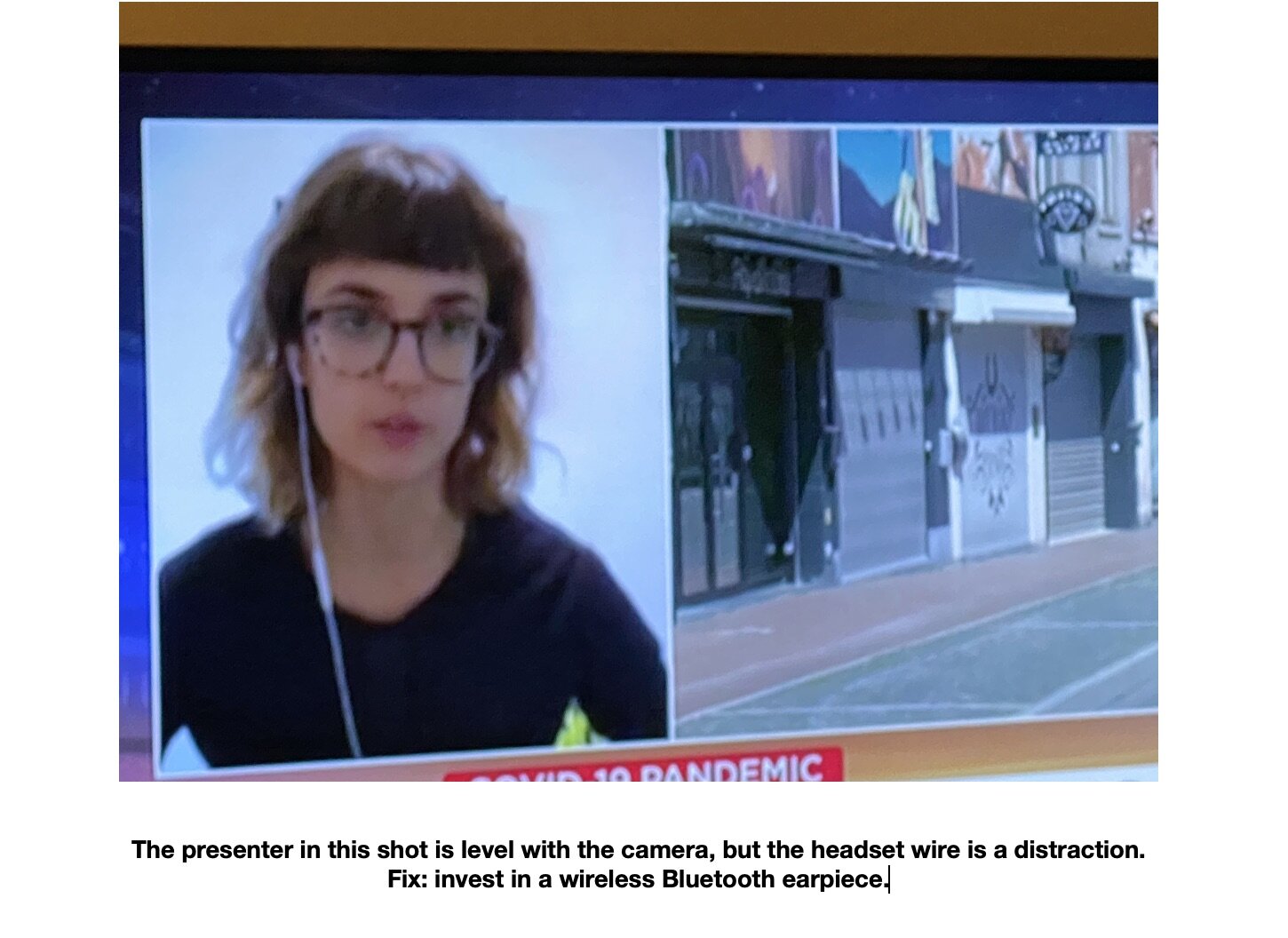
  Relating to the camera has now become one of the most important business skills of the COVID era. Click through the gallery to see examples good and bad.  Image courtesy    visuals    via  Unsplash .

Relating to the camera has now become one of the most important business skills of the COVID era. Click through the gallery to see examples good and bad. Image courtesy visuals via Unsplash.

carousel 2.jpg
carousel 3.jpg
carousel 4.jpg
carousel 5.jpg
carousel 6.jpg

YOUR UNSEEN AUDIENCE: Four practical tips for excelling on remote video platforms

Steve Dunlop June 8, 2020

Media commentary by Steve Dunlop  

Listen to podcast version here

On the now-long-defunct New York radio station WPIX-FM, I once heard a popular disc jockey in a revealing moment of on-air candor. He was describing what it’s like to play hit records and spit out one-line gags to millions of listeners he could not see. “This job,” he announced, “is the closest thing you can imagine to getting paid to giggle in a closet.”

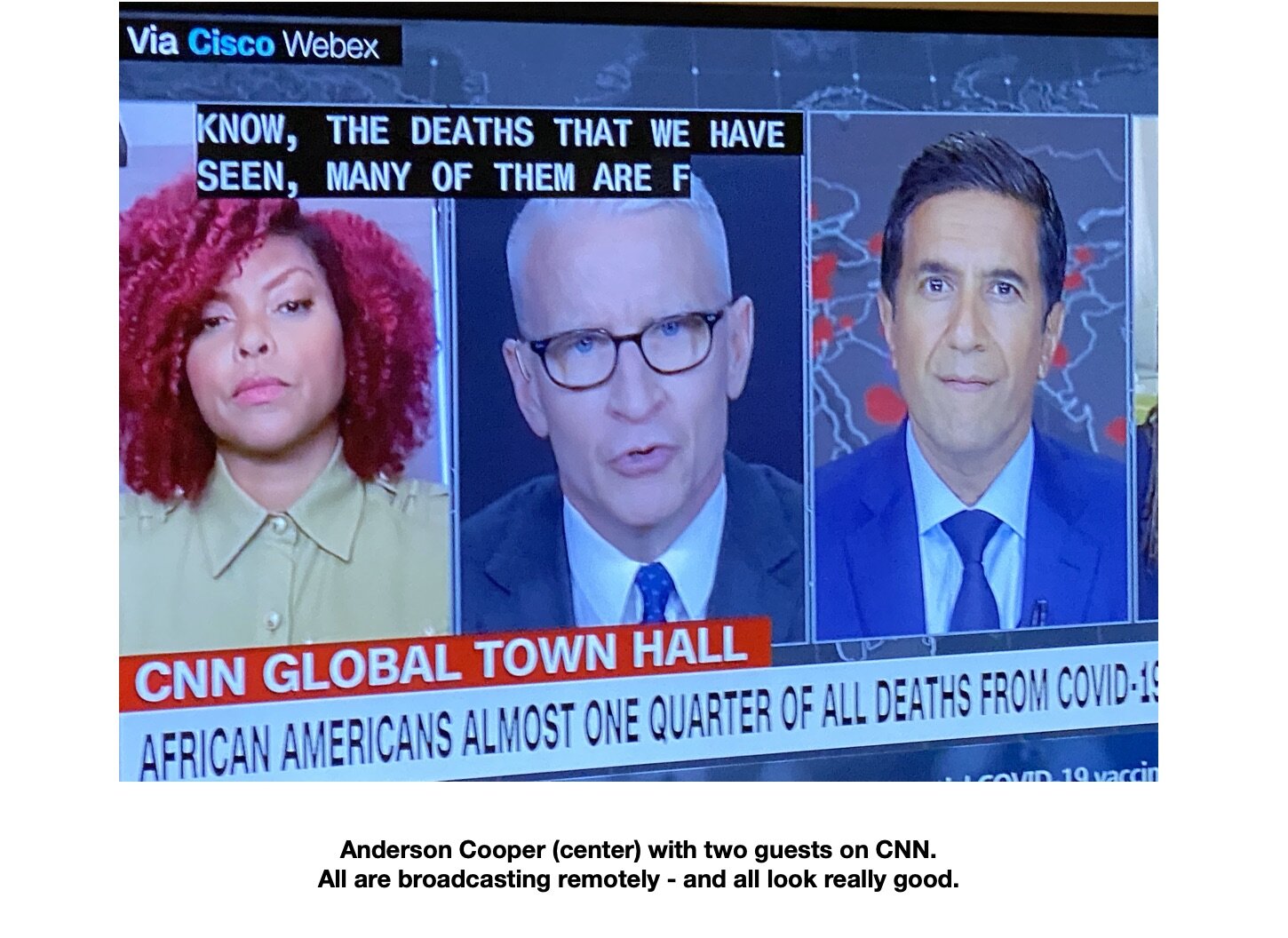
As the COVID-19 pandemic drags on, nobody’s giggling - but a lot of us can relate to that closet. Executives and managers across the business spectrum used to projecting authority and leadership in a boardroom have had to figure out how to do that from their basement. Or their dining room table. When the only entities physically present aren’t their employees - but their kids doing homework. Or their cat on the scratching post. Or their spouse - who actually might be conducting a Zoom meeting all their own from the den. It all taxes far more than just your household bandwidth.

And when companies like Facebook say they will encourage a large portion of their staff to work from home - not just until a COVID vaccine is available, but permanently - you know that even as we reopen, none of this is likely to change.

Which means relating to the camera - something only TV presenters used to worry about - is now becoming one of the most important business skills of the COVID era.

Since the onset of the pandemic, all our media trainings, presentation trainings, and crisis workshops have been offered virtually. We’ve culled many takeaways from this work, but there are four big ones so far. If you do nothing else to up your game, do these:

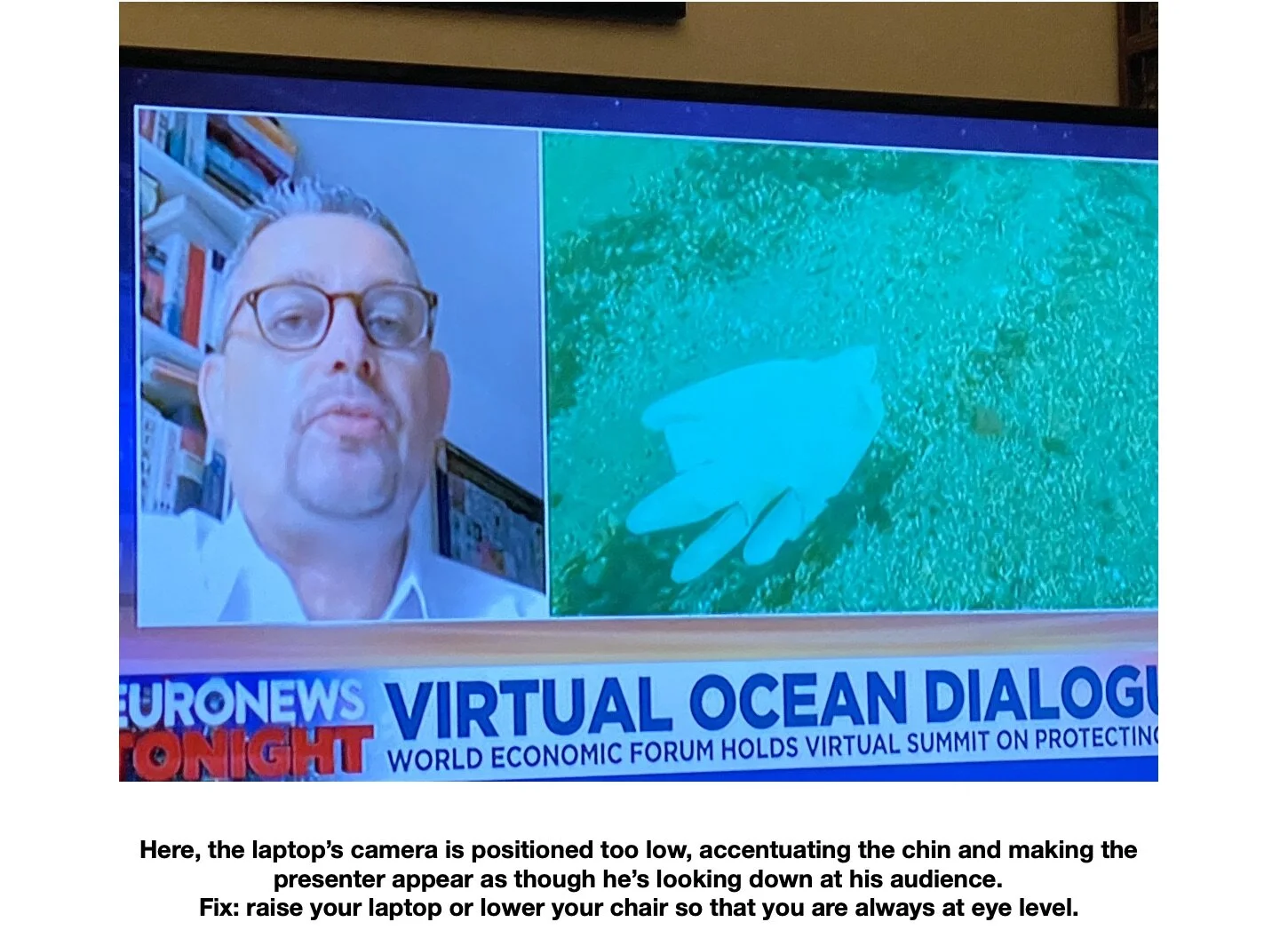
1. GET STARTED EARLY. If you’re the organizer, start your remote meeting at least 5 minutes before the scheduled time. Raise your computer to eye level so you are not condescendingly looking down at your audience. Use a stand, or set it on books if you have to. Lowering your office chair can help achieve the same effect. And whether you’re the organizer or a participant, make sure your audio and video are both working before you enter the meeting. Don’t waste your colleagues’ valuable time by searching for the unmute button on your microphone.

2. LET THERE BE LIGHT. Diffused natural light is best. For a daytime meeting, if you are fortunate enough to have a large window in your office, face it directly, and have that function as your key light. Eliminate the light sources in back of you - they cast shadows and make it more difficult for your audience to see you. When there’s no window, don’t set up a light to hit you directly in the face. Try moving it, shading it, or bouncing it off a wall to mimic the indirect effect of daylight.

Steve Dunlop anchoring the New Jersey Update on WNEW-TV, 1984. Click to play the video and note how distracting the turnpike traffic in the window  behind him becomes.

Steve Dunlop anchoring the New Jersey Update on WNEW-TV, 1984. Click to play the video and note how distracting the turnpike traffic in the window behind him becomes.

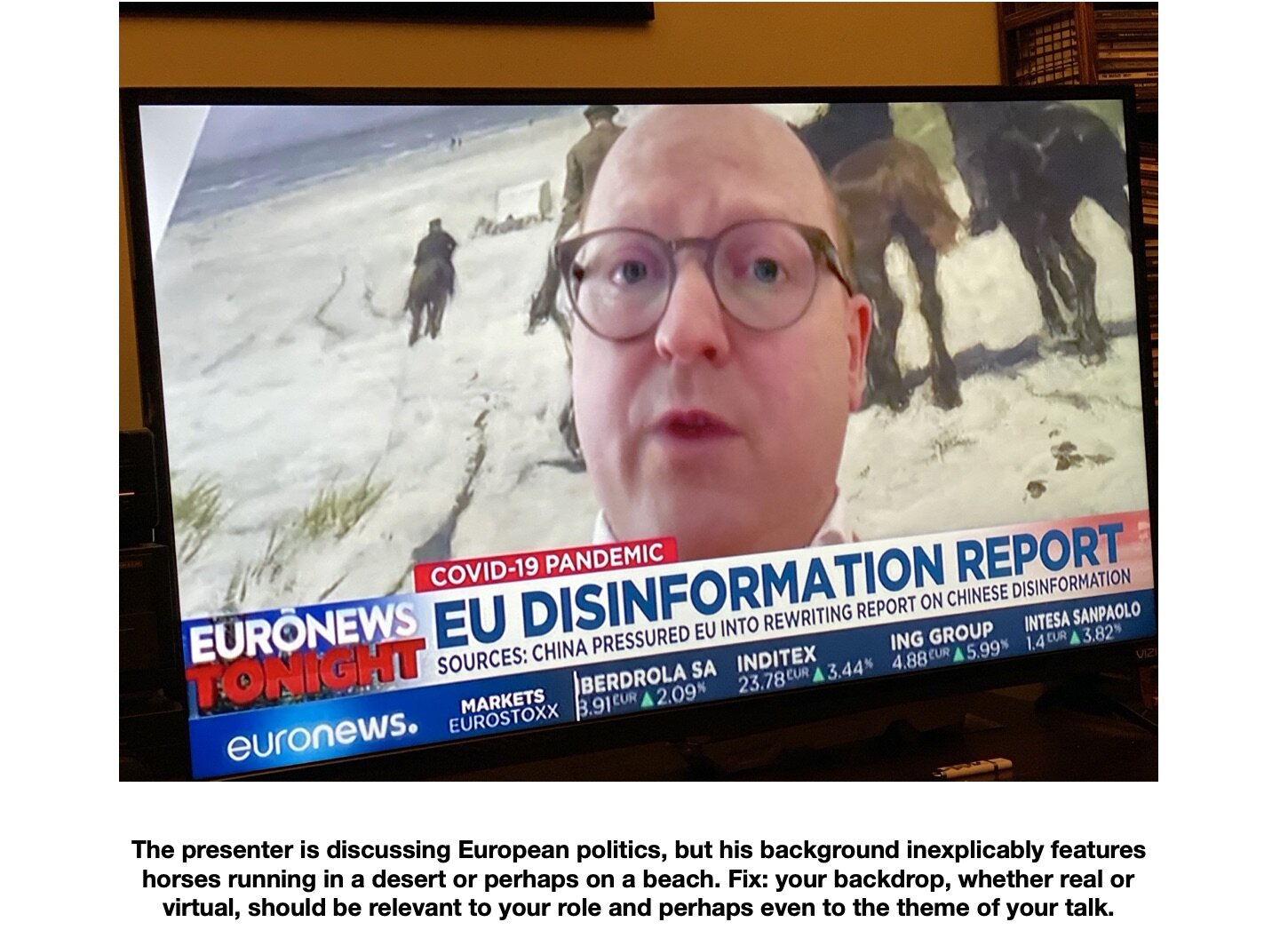
3. CHOOSE YOUR BACKDROP CAREFULLY. You want people to focus on you - not the visual distractions in back of you. I learned this long before COVID. In the 1980’s I did a daily newscast from the New Jersey bureau of Fox 5 New York - then known as WNEW-TV. My background was a live shot out our window, overlooking the New Jersey Turnpike. What most people remember about my newscast isn’t what I said - but the cars and trucks that looked like they were going in one side of my head and out the other. I was ribbed about it constantly.

Some video platforms allow you to choose a virtual background, but be careful. These digital tricks can sometimes backfire, shaving your head and cropping your ears - cheapening your short with an ill-defined outline, making you look like you’re calling in from another planet.

4. LOOK AT ME. When you are speaking - and especially when you’re not screen sharing - keep your eyes focused squarely on the pinhole camera on your laptop. The temptation is strong to look at the rest of your screen, but remember - that’s what your audience will see: you looking at your screen, and not at them. Yes, you should also keep your audience in view. One trick is to drag the window of your video platform upwards on your screen, as close to the camera as you can - making it possible to split the difference.

A number of years ago I worked with a senior executive who abhorred the idea of appearing on camera. I remember him walking in before our first practice session and proclaiming, “Time for my root canal.” That sort of attitude might have been understandable in the rotary phone age, but it will not cut it in the era of WebEx, Skype, and Zoom. And even when society fully reopens and full scale face to face meetings resume… the on-camera era is here to stay.

To learn more about our services addressing this urgent need, click here.

Listen to the podcast of this Press Center Commentary here.

Comment
1280px-SMPTE_Color_Bars_16x9.svg.png

YOUR ONLINE LECTURE IS TELEVISION

Steve Dunlop March 18, 2020

Educators everywhere are finding themselves in a scary new role: online television presenters. We offer remote individual and group coaching in this area, but here are some quick tips to get you started.

Media commentary by Steve Dunlop  

Listen to podcast version here

The coronavirus pandemic is changing all of our lives in ways large and small. Restaurants and pub crawls are out - social distancing is in. Trips to the gym are dangerous. Long hikes in the woods or on the beach are becoming trendy. And teachers - in a myriad of ways, the custodians and transmitters of our civilization’s achievements - have suddenly found themselves thrust into a scary new role for which many are utterly unprepared.

A college professor friend of mine emailed me. “I have been under orders to instantly become an online teacher for the rest of the semester,” he told me. He included a cut-and-paste link to an online lecture on how to build an online lecture. Unfortunately, he said, it was sold out.

It’s time for us all to take a deep breath - as long as you’re standing 10 feet away from anyone else - and recognize something fundamental about having to move to online teaching in a pinch. It is simply this: that online lectures - at their essential core - are television.

Do not confuse the attributes with the essence - or the accidents with the substance, as Aristotle might say.  An online lecture might include some Web-like interactivity.  It might be watched in small snippets, instead of in hour-long chunks.  And you will probably experience it on your iPad instead of in your living room.  Delivery methods have changed and will change, but they have nothing to do with the core of the experience.  

Online lectures, at bottom, are people, pictures, and ideas on a screen.   They are television.  

As a coach who has helped thousands of individuals communicate more effectively in the visual medium, let me offer four quick pointers on how to think of your new task as making television.

-  Tell stories.    "A growing body of cognitive research," wrote Chrystia Freeland in 2010 before she became Canada’s deputy prime minister, "is demonstrating something schoolteachers and entertainers have known for a long time: Most of us respond better to personal stories than to impersonal numbers and ideas." Television figured out a long time ago that the medium at its best when it tells stories.  That means setting up your lectures with a strong narrative arc from beginning to end, and making use of short anecdotes to drive home your themes.  
-  Keep it short.  It’s one thing for your student to sit in a lecture hall for an hour. It’s quite another for them to download your online lecture and see an hour-long timeline at the bottom of their screen. Make your material less intimidating and more engaging by breaking it up. Think micro-lectures of 4 to 6 minutes. You can probably double that length if your subject matter is especially compelling and you’re really telling stories.
-  Loosen up.   Too many online lecturers come across as dweebish and boring.  That may be acceptable - barely - with a captive audience in a lecture hall.  It is lethal for your prospects on television.  Learn how to relate to the pinhole camera on your laptop, which is the principal conduit to your unseen audience.  Imagine you’re sitting across the table from one of your smartest students. Look him or her in the eye. Get excited about what you’re conveying. And don’t be afraid to extemporize.
-  Break out of the visual jail.   Too many lecturers are lazy when it comes to the visual element.  I’ve seen some, for instance, resort to handwritten notes captured by a virtual pen application.  It's about as exciting as watching paint dry.  Think creatively about visuals that could enhance your lecture - many of them are available at little or no cost in places like Wikimedia Commons.   Ken Burns could make the Civil War come to life with creative use of tintypes, because he understood how to use them.  You can too.

"This instrument," Edward R. Murrow said of television in 1958, "can teach, it can illuminate; yes, and it can even inspire.  But it can do so only to the extent that humans are determined to use it to those ends."   Your online lectures are television - there is no avoiding that truth.  If educators are truly determined to make the world their classroom, they have to learn how to adapt to the medium - and not expect the medium to adapt to them. 

To learn more about our services addressing this urgent need, click here.

Listen to the podcast of this Press Center Commentary here.

Comment
image-asset.jpeg

HOW TO TALK ABOUT THE CORONAVIRUS

Steve Dunlop March 5, 2020

Four basic principles communicators should follow in any health emergency

Media commentary by Steve Dunlop  

Listen to podcast version here

At the time of the historic Three Mile Island nuclear accident, I was a young news editor at New York’s WOR, which was then one of the most influential radio stations in the country. I was responsible for thirteen newscasts each day, along with news headlines, sports headlines, and assigning our reporters to stories in the field.

One day when I was arriving to work the afternoon shift, the desk assistant told me a medical doctor was on the phone, and wanted to speak with an editor. The doctor introduced himself and then stunned me with a simple question.

“Do you realize,” he said, “that your newscaster just gave out a lethal prescription on the air?”

Lethal, I wondered? I knew we had reported on fears of a Three Mile Island style accident at the Indian Point nuclear plant just north of the city. A local lawmaker had been calling on schools to take the precaution of stocking potassium iodide pills, which block the thyroid’s absorption of radioactivity, so that they could be distributed to students in an emergency.

I went back and checked the news anchor’s script from the shift before mine began. He had accidentally written that the schoolchildren should be given, not potassium iodide, but potassium cyanide. The previous editor had missed it. Hundreds of thousands of people had heard it. Obviously, we issued a correction.

Of course, no school followed that advice, and there was no accident at Indian Point. But it impressed on me the overarching importance of disseminating accurate information, especially when it comes to public health, and really taking the time to proofread and vet it before pushing it out.

Three Mile Island is history, of course. We live in the fake news era, where media is entertainment, basic information seems pliable, and forces are at work across the political spectrum to take facts and twist them to fit this or that agenda.

But in a health crisis there is no room for politics, games or misstatements. Whether you’re communicating urgent information to the news media, your stockholders, or your own employees in a crisis, accurate, verifiable facts are paramount.

But facts inherently need context to be understood. Context is what we brought to our work with the Centers for Disease Control a few years back, and it’s what we desperately need to communicate with the right balance in the coronavirus epidemic.

So accuracy is job one. But it’s just a start. What follows here is only a sliver of we cover in our communications trainings on a public health situation, but these three additional guideposts are musts:

Clarity. Avoid health care jargon that may be understood by you, but not by others. Keep your words simple. I like to suggest the “Uncle Ralph Test.” If your Uncle Ralph will understand your phrasing, go with it. If he won’t, don’t. Whenever possible, use first or second person pronouns to keep your tone conversational and approachable.

Precision. Use simple words, yes, but choose them carefully. Keep in mind that your audience in a crisis is listening with heightened anxiety. Strive for language that doesn’t lend itself to misinterpretation, especially by people who might only be half listening or distracted. And learn strategies for answering questions that incorporate that same principle of precision.

Empathy. The coronavirus does not infect rocks or trees. It attacks human beings, with real lives, loved ones and livelihoods. Remember that every health crisis is at its core a human crisis. Speak with compassion for those suffering, and genuine understanding of the emotions in play. And even if your message is inherently alarming, and your options limited, people still want to know what they can do. Whatever simple, actionable advice you can offer, move it high up on your narrative.

As of this writing, it appears that outbreaks of what the scientists call COVID-19 will be part of our global landscape for some time. Which brings me around to a fifth suggestion for communicators. Stay informed. With each wave of infection, the scientists on the front lines of halting this epidemic are learning something to apply to the next. I don’t agree with the philosopher Friedrich Nietzsche about very much, but one of his aphorisms makes good sense to this day. “That which does not kill us,” he said, “makes us stronger.”

To learn more about our services addressing this urgent need, click here.

Listen to the podcast of this Press Center Commentary here.

Comment
  • From The Center
  • Older
  • Newer
linkedin
  • Contact us

THINK. SPEAK. EDUCATE.™

Creators and exclusive teachers of the PATH™ and SPAR® communications curricula. 

© 2026 DUNLOP MEDIA INC.  ALL RIGHTS RESERVED.  BY USING OR ACCESSING THIS SITE YOU ARE AGREEING TO DUNLOP MEDIA'S TERMS AND CONDITIONS. 

Dunlop Media

THINK. SPEAK. EDUCATE. ™

The Chrysler Building | 405 Lexington Avenue, 26th floor, New York, NY 10174, USA

linkedin